Who Owns New York's 94 Methadone Clinics? The Federal File Doesn't Say
Private equity owns about a third of US methadone clinics. New York's 94 are still nonprofits and hospitals, and no public record shows who owns them.
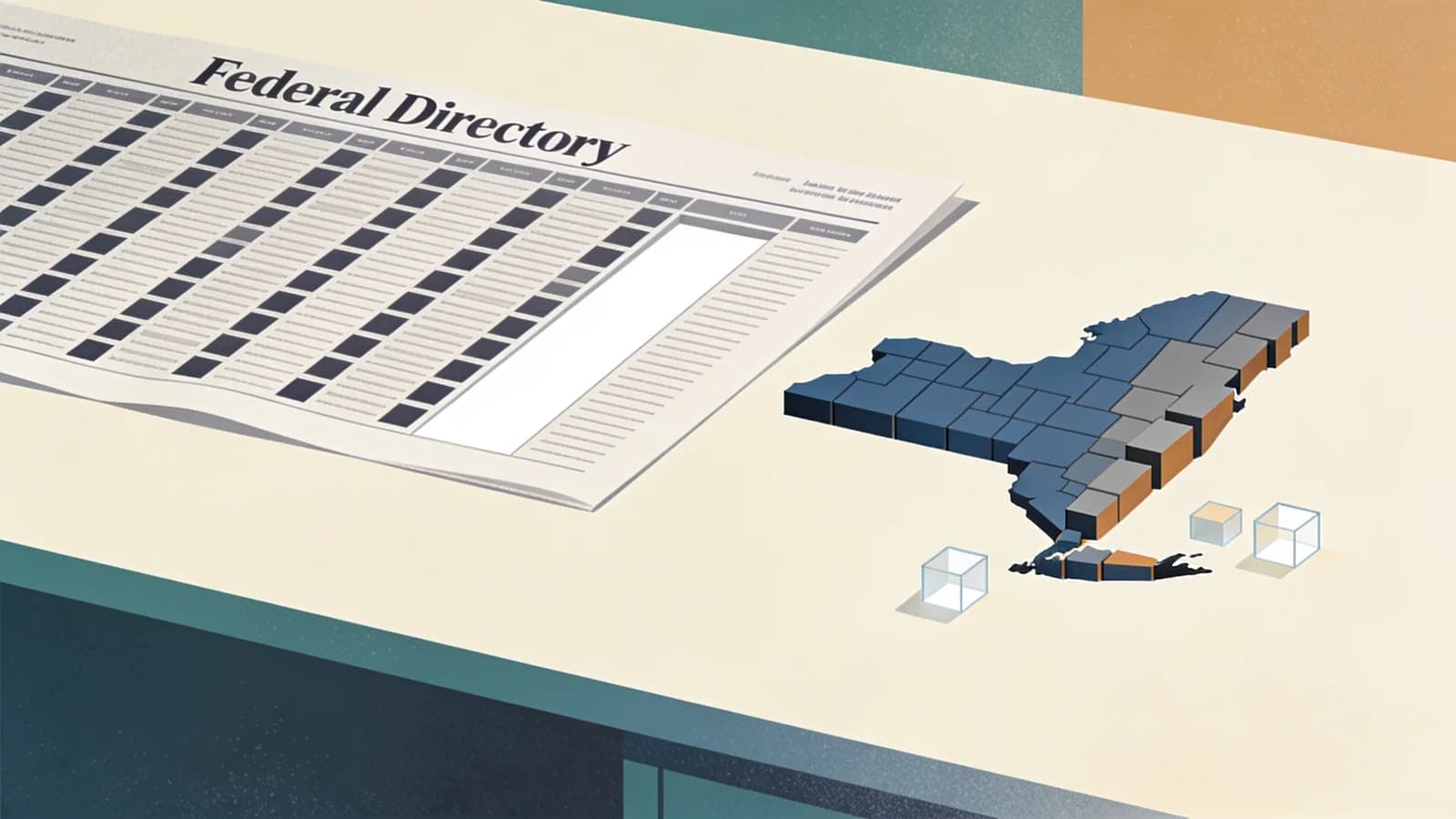
The federal government publishes a list of every methadone clinic in the country. It is a spreadsheet, refreshed weekly; the version posted October 26 runs to 1,579 rows. Nine columns wide: NPI number, provider name, two address lines, city, state, ZIP, the date the clinic's Medicare enrollment took effect, and a phone number.
Ninety-four rows say NY.
Read those rows and a shape appears. There is Montefiore, five locations. Start Treatment and Recovery Centers, seven. The Puerto Rican Organization to Motivate, Enlist and Sustain, six. St. Joseph's Hospital in Yonkers, four. Conifer Park in Glenville, four. Three sites run by the Sisters of Charity Hospital in Buffalo, two by Samaritan Daytop Village, one by the state's own Office of Mental Health at Bellevue.
What is missing from the file is the thing everyone in health policy is now arguing about. There is no column for ownership.
What the Federal Register of Clinics Actually Contains
Medicare began enrolling opioid treatment programs as a distinct provider type in 2020, which is why the file exists. It is an enrollment list, not a registry of corporate structures. It tells you which legal entity signed the paperwork and where it dispenses. It does not tell you who controls that entity, who bought it, or what debt sits on it.
That gap was tolerable while methadone clinics were a sleepy corner of the safety net. It stopped being tolerable once they became an asset class. Researchers at Brown, Pittsburgh and RAND spent two years matching PitchBook acquisition records against federal methadone shipment data precisely because the ownership question could not be answered from any public list. Their finding, published in Health Affairs, is that private equity firms acquired 358 individual opioid treatment programs between 2011 and 2022, spread across 43 states.
After the deal closes, the acquiring firm typically controls the market it just entered. In the median county that saw any acquisition, the buyer held 60.6 percent of the methadone market in the year of purchase and 67.1 percent two years later. In more than one county in four, a single firm ended up with all of it.
That is roughly double the 30 percent share at which the Department of Justice and the Federal Trade Commission treat a company as presumptively anticompetitive.
Why a Methadone Clinic Is Not a Normal Business
Methadone is not like buprenorphine, which any licensed prescriber can write and any pharmacy can fill. For the treatment of opioid use disorder it can be dispensed, in the United States, only through a program certified by SAMHSA and licensed by the state.
The clinic is the medication. If there is one program in a county and it belongs to a chain, the chain is the only route to methadone for anyone who cannot drive to the next county. Competition does not arrive the way it does in other industries, because opening a competitor means clearing federal certification and a state licensing process and finding clinical staff in a shortage.
The math of a captive market
Treatment itself creates recurring, predictable demand. A new patient doses daily at the start. Under 42 CFR § 8.12, take-home doses are capped at seven days during the first two weeks, then 14 days from day 15, then up to 28 days from day 31, plus closed-day doses regardless of how long someone has been in treatment. Most patients who want to stop coming every morning have to earn that over months at the same address.
The Health Affairs team tested whether new owners used that position to grow supply. They did not, at the market level. Methadone shipments to acquired clinics rose 13 percent, but the increase vanished once pre-acquisition trends were accounted for. County-level methadone shipments were flat. So were opioid overdose deaths.
That is not evidence that private equity is harming patients. It is evidence that a wave of dealmaking, justified to regulators on the grounds that it would expand access, did not expand access.
New York's List Looks Nothing Like Ohio's
Of the 58 distinct provider names in New York's 94 rows, 31 look like community nonprofits, 19 like hospitals or health systems, three are county agencies, and five are business entities — a list that includes a single-physician Queens practice and a corporation in Buffalo.
| New York's Medicare-enrolled OTP locations, October 2026 | |
|---|---|
| Total locations | 94 |
| Distinct provider NPIs | 71 |
| Inside the five boroughs | 51 |
| Outside New York City | 43 |
| Nonprofit or community organization names | 31 |
| Hospital or health-system names | 19 |
| County government | 3 |
| Business entities | 5 |
Not one row carries the name of the chains that dominate other states. BayMark Health Services, which the Health Affairs authors identify as the largest private-equity platform in the country at 102 programs in 28 states, does not appear. Neither does Aegis Treatment Centers, at 83 programs in eight states, nor Journey to Hope, Health and Healing at 91 programs across 22 states.
Outside the city, New York's coverage is thin and local: three locations in Buffalo, two each in Rochester, Syracuse, Albany, Schenectady and Utica, single programs in Binghamton, Elmira, Olean, Poughkeepsie and Carmel. That thinness is not a virtue. It is the same scarcity that has left New York's own treatment expansion dependent on nonprofit operators — St. Joseph's opening Franklin County's first methadone clinic in Saranac Lake this fall, Helio Health opening in Gloversville in July, a new Rochester facility the same month.
Names are not ownership
The comfortable reading of that table is that New York is immune to the consolidation that reshaped Ohio and California, where the study counted 26 and 58 acquisitions respectively.
The defensible reading is narrower. New York's public records list the entity that signed the Medicare enrollment form. They do not list the parent company, the management services organization, the real estate investment trust that owns the building, or the fund that owns the operator. A private equity platform buying into New York has every reason to keep the local name — a clinic called Putnam Family Services raises no eyebrows, while a clinic called BayMark does.
Montana shows how complete the effect can be. As Fortune reported on October 30, one company, Community Medical Services, owns all four of that state's methadone clinics, three of North Dakota's four, and the clinic a patient in Arizona drives to. It bought them under its own name, so the public record happens to be legible. That is luck, not transparency.
The Money Arrived in 2020
Two changes made methadone clinics attractive to investors, and New York is exposed to both.
The first is federal payment. Medicare began covering methadone treatment in 2020, converting a service funded largely by state grants and self-pay into a billable medical benefit. The second is scale. As of 2020, 62 percent of the country's roughly 1,900 programs were already owned by for-profit companies; the Health Affairs study put the private-equity share at about 30 percent by 2022, and the lead author now puts it at 35 percent of the roughly 1,572 programs registered with Medicare, with more than half in 19 states and the District of Columbia.
New York's version of that money is Medicaid. The state's opioid treatment programs are licensed through OASAS operating certificates, and Medicaid pays for the dosing, counseling and toxicology that make up the bundle. When the state raises rates or widens eligibility, it raises the value of every certificate in the state — including certificates held by whoever happens to own them.
There is one more piece of the case against complacency. A separate study of buprenorphine, the medication that does not require a clinic, found that after private-equity acquisition the share of patients who stayed continuously on treatment for 180 days fell by nearly eight percentage points. Early discontinuation is one of the strongest predictors of relapse. Methadone has not been studied the same way, in part because the data does not exist.
What Albany Is Arguing About Instead
New York is not ignoring corporate ownership in medicine. It is simply not aimed at this.
On October 29, Assemblyman Jonathan Jacobson and Senator Michelle Hinchey rolled out a package aimed squarely at UnitedHealth and its subsidiary Optum, which has been buying medical practices across the Hudson Valley. One bill would bar insurers from owning providers outright. Another would prohibit overlapping ownership among insurers, pharmacy benefit managers and pharmacies. A third would ban noncompete agreements for clinicians, and a fourth would require insurers to pay independent practices at least what they pay affiliated ones. The lawmakers say they will push the bills in the next session.
Each addresses a real conflict. None reaches a methadone clinic owned by a fund that is neither an insurer nor a pharmacy chain.
Other states have gone further on disclosure. Vermont enacted restrictions on private equity and hedge fund involvement in health care this year. Indiana, California and Maine have advanced or passed laws requiring ownership disclosure as a condition of billing Medicare or Medicaid. New York has no equivalent, which is why the question "who owns this clinic" has no official answer here — for methadone or for anything else.
Senator Maggie Hassan of New Hampshire has opened an investigation into three of the largest methadone-clinic operators, focused on whether they have opposed easier access to the medication for financial reasons. That inquiry says nothing about a clinic in Elmira.
What a Patient Can Still Ask
The ownership layer is not visible from the parking lot, but a few things are.
Any New York program holds an operating certificate issued by OASAS, and the certificate holder is the party responsible for the care delivered inside. A patient can ask the front desk which entity holds it, and can ask whether the program is part of a larger organization. A program that cannot answer the second question is telling you something.
Take-home eligibility is set by federal rule, not by ownership, and the schedule is worth knowing because it is the main thing that separates a livable treatment regimen from an unlivable one: seven days of take-home doses in the first 14 days of treatment, 14 days from day 15, up to 28 days from day 31, and closed-day doses from the beginning regardless of tenure. A program that withholds take-homes beyond what the regulation allows is a program to raise with the state.
Complaints about a certified program go to OASAS, which publishes a patient-rights notice and investigates grievances against its own providers.
The Watch List
Three things would settle the question of whether New York's nonprofit character is a fact or an accident.
The first is a deal. If a national platform buys a New York program and the operating certificate transfers to a subsidiary with a local-sounding name, nothing in the state's public record will flag it. Watch the OASAS certificate transfer notices, not the press releases.
The second is the next legislative session. If the Hudson Valley package moves, the fight will be about whether disclosure requirements aimed at insurers and pharmacy middlemen get extended to investors in treatment programs. That is a single amendment away, and it is the difference between knowing and guessing.
The third is federal. The Medicare payment that made these clinics valuable is a rate, and rates get revised. So does the rule that keeps methadone inside certified programs — a change there would alter the economics of every clinic in the state overnight.
Until one of those three moves, the honest answer to who owns New York's methadone clinics is that the state's own records cannot say, the federal file does not ask, and the market that answered the question everywhere else has not finished arriving.
Written by
MTNYC Editorial TeamThe MTNYC Editorial Team is a group of healthcare writers, researchers, and addiction specialists dedicated to providing accurate, compassionate, and evidence-based information about addiction treatment and recovery resources in New York State.