NY Overdose Deaths Fall 45% Since 2022, Hochul Says
New York overdose deaths fell about 45% from 2022 to 2025 — from 6,630 to 3,775 — as the state spent $500M in settlement funds and shipped 1.4M naloxone kits.
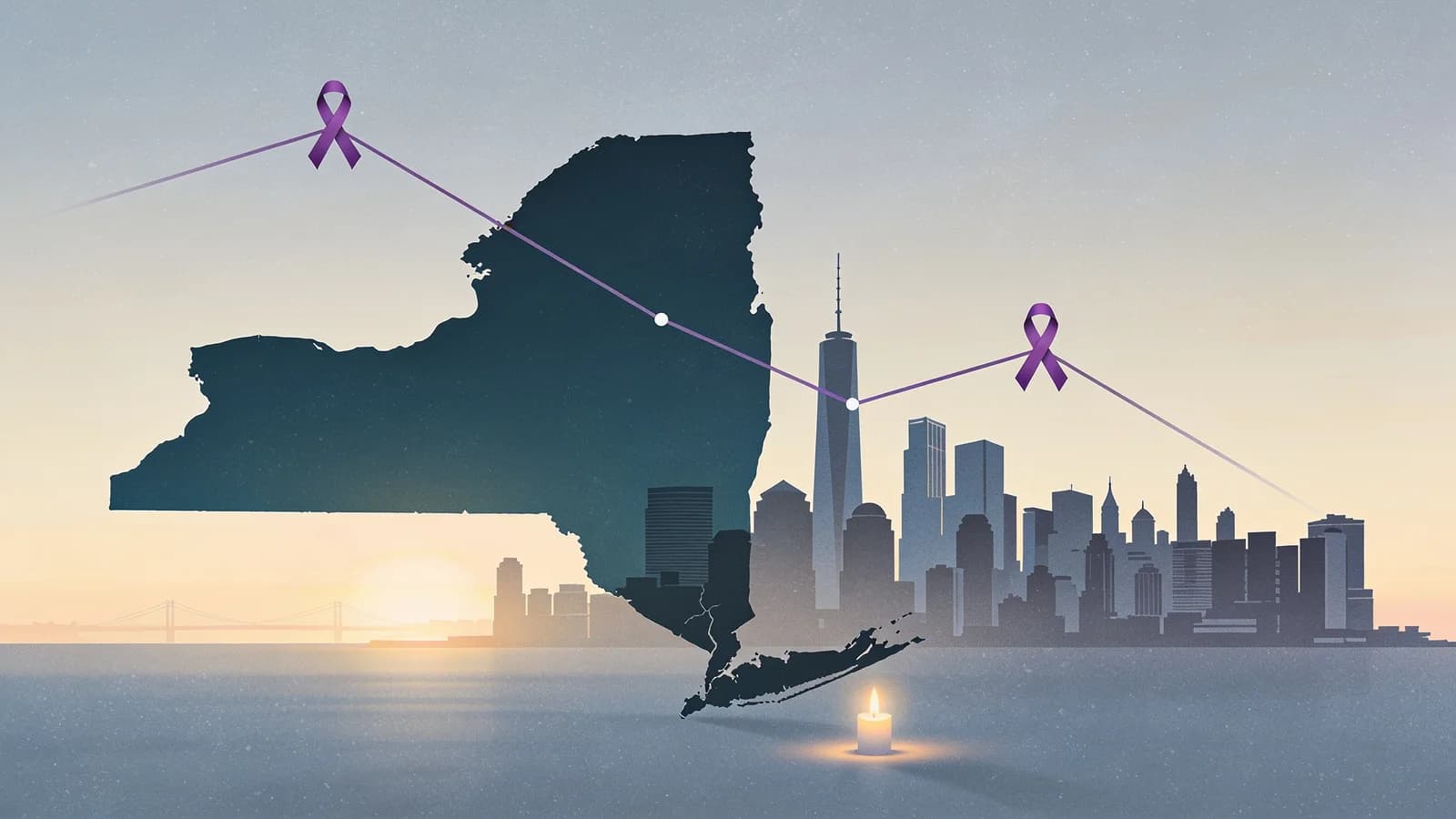
Eighteen people a day. That was the pace of the overdose epidemic in New York in 2022 — 6,630 deaths over the course of the year, a toll that touched every county in the state. The newest federal data tells a different story: an estimated 3,775 deaths in 2025, closer to ten a day. The roughly 45% decline, announced by Governor Kathy Hochul on International Overdose Awareness Day, is the steepest sustained drop the state has recorded since fentanyl began driving fatalities upward nearly a decade ago.
The announcement, drawn from data compiled by the Centers for Disease Control and Prevention, landed on August 31 — the day set aside each year to remember those lost to overdose. Landmarks across the state were lit purple that evening in their honor, a gesture meant to acknowledge both the progress and the grief that sits underneath it.
The Numbers Behind the Announcement
The trend is visible in both raw counts and daily averages:
| Year | Overdose deaths in NY | Average per day |
|---|---|---|
| 2022 | 6,630+ | ~18 |
| 2025 | 3,775 (estimated) | ~10 |
A 45% reduction over three years is not a statistical wobble. Provisional CDC figures can drift slightly as coroners close investigations and late death certificates arrive, but a shift of this size holds up under revision. It also outpaces the national trend by a wide margin — more on that below.
Context matters here. In 2022, New York was still climbing out of the worst overdose years in its history, a period when fentanyl had fully displaced heroin in the street supply and counterfeit pills were pulling new groups of users into risk. A decline from a record peak is easier than a decline from an average year. Even so, no one in the state's treatment community expected a drop this large, this fast — and the officials announcing it were visibly aware of how unusual the moment is.
State officials were careful to frame the numbers as progress rather than victory. Ten deaths a day is still ten families a day. But after years in which each new report seemed worse than the last, the direction of the curve has clearly changed.
How New York Got Here
The state's overdose crisis built in three waves. The first was prescription painkillers in the early 2000s, when aggressive marketing of opioids seeded dependence across suburbs and small towns alike. The second was heroin, which filled the gap when prescribing tightened. The third — and deadliest — was fentanyl, a synthetic opioid fifty times stronger than heroin, which by the late 2010s had contaminated nearly every corner of the illicit drug supply, from counterfeit oxycodone tablets to cocaine.
Each wave pushed the death count higher, and each policy response lagged a step behind. New York expanded treatment licensing, stood up overdose prevention centers, and poured state money into naloxone distribution, yet the numbers kept climbing through the pandemic years, when isolation and disrupted services compounded the damage. The 2022 peak of more than 6,630 deaths was the grim summit of that two-decade climb.
The legal reckoning that followed produced the money now funding the response. New York sued opioid manufacturers, distributors, and pharmacy chains alongside other states, and the resulting settlements — including the landmark agreements with Purdue Pharma's owners and the national deals with major distributors — directed billions to abatement nationwide. New York's share, governed by statute so that settlement dollars flow to addiction services rather than general budgets, became the financial backbone of the current effort.
What changed after 2022 was not one policy but a convergence: settlement money began flowing at scale, naloxone became genuinely ubiquitous, and treatment infrastructure that had been built during the worst years finally had the funding to operate at capacity. The 45% decline is the first hard evidence that the convergence is working.
What the State Credits for the Decline
The Hochul administration points to money first. Since fiscal year 2023, New York has made nearly $500 million in opioid settlement funds available for prevention, treatment, harm reduction, and recovery programs — dollars extracted from the manufacturers, distributors, and pharmacies whose practices fueled the crisis. That spending has shown up in concrete form: new treatment beds, 24/7 access centers, mobile outreach units, and county-level programs that did not exist three years ago.
The second pillar is naloxone. The state has shipped more than 1.4 million kits of the overdose-reversal medication to registered programs since August 2022, saturating communities with a tool that bystanders, librarians, bar staff, and family members can use in the minutes that decide whether an overdose becomes a death. When reversal happens quickly, the fatality statistics never get the chance to record a name. Harm-reduction advocates argue — and the data increasingly supports them — that this saturation is the single largest driver of the mortality decline, more than any treatment expansion.
Treatment capacity has grown alongside it. Settlement dollars and state appropriations have funded medication-assisted treatment in jails, expanded buprenorphine prescribing through telehealth, and kept crisis stabilization centers open around the clock. The shift toward low-threshold access — walk-in buprenorphine starts, same-day appointments, mobile prescribing units — matters as much as raw capacity, because the window between someone deciding to seek help and someone changing their mind is often measured in hours. None of these programs is individually responsible for a 45% drop. Their combined weight appears to be.
"Every part of New York State has been impacted by the overdose epidemic, and while we have made significant progress in reducing deaths, we continue to lose too many New Yorkers," said OASAS Commissioner Dr. Chinazo Cunningham. "These are not just numbers, they are people."
State Health Commissioner Dr. James McDonald echoed the framing, crediting "countless dedicated community partners, investments in innovative harm reduction programs and access to prevention tools, education and resources" — and setting the goal plainly: "an overdose-free generation."
New York Is Outpacing the Nation
The national picture is improving too, but more slowly. The CDC's provisional estimate for the twelve months ending in March 2026 puts U.S. overdose deaths at 67,798 — a 12.3% decrease from the prior year. Meaningful, and the continuation of a welcome trend, but a fraction of New York's 45% three-year drop.
To help other states close that gap, the CDC used Overdose Awareness Day to launch its Overdose Prevention Data Channel, a single platform combining fatal and nonfatal overdose data from three federal surveillance systems — the State Unintentional Drug Overdose Reporting System, the Drug Overdose Surveillance and Epidemiology system, and the National Vital Statistics System — with evidence-based prevention strategies and information about federal programs. "The most useful data does more than show us what has happened; it helps us decide what to do next," said Dr. Grant Baldwin, director of the CDC's Division of Overdose Prevention. CDC Director Dr. Erica Schwartz framed the launch as a transparency push, saying the agency wants "maximum transparency to empower patients, providers, and other stakeholders."
Why New York is running ahead of the national curve is a question researchers will be answering for years. The leading explanations are not mysterious: the state layered settlement money onto an already-large treatment infrastructure, pushed naloxone into hundreds of thousands of hands, and legalized harm-reduction tools that many states still restrict. States that moved slower on any of those three fronts are seeing smaller declines — or none at all. There is also a demographic reality underneath the policy story: the national decline has been uneven across age groups and regions, and some of the steepest drops have come in places where the crisis peaked earliest and hardest. New York fits that profile.
Whether each dollar produced equal benefit is another matter. The state's own spending reports have drawn scrutiny over how quickly settlement funds reach frontline programs, and advocates continue to press for clearer accounting of what the money buys. A falling death count does not settle those questions; if anything, it raises the stakes on spending the remainder well.
What It Looks Like at the County Level
Statewide percentages can feel abstract. Monroe County's experience makes it concrete.
The county used opioid settlement money to fund round-the-clock access at Delphi Rise, a treatment center in Gates, backed by a $4.5 million grant spread over five years. It made naloxone available at 605 locations last year. And so far this year, the county's overdose dashboard shows 767 overdoses, 81 of them fatal — with August accounting for 73 overdoses and 8 deaths. The county's numbers, like the state's, have been trending downward for the past couple of years.
That pattern — local money, local naloxone, local treatment capacity, local decline — is repeating across counties that moved fastest to stand up programs. The declines are not evenly distributed. Rural counties with thinner infrastructure still face longer ambulance response times, fewer prescribing clinicians, and treatment slots that can be an hour's drive away. Several upstate counties have also warned that state-mandated jail medication programs, while effective, arrive without enough state funding to run them — a tension that will shape how evenly the decline spreads from here.
What the Death Count Doesn't Capture
Mortality is the headline metric, but it is the tip of a much larger iceberg. Monroe County's dashboard illustrates the ratio clearly: 767 overdoses so far this year produced 81 deaths. Behind every fatal overdose stand roughly nine nonfatal ones — each an emergency response, a hospital visit, a family in crisis, and often a missed opportunity to connect someone to treatment.
Nonfatal overdoses are also where naloxone saturation shows up most directly. Many of this year's survivors are alive because someone nearby had a kit and knew how to use it. Those rescues rarely make headlines, and until recently they were barely counted; the CDC's new data channel is an attempt to close that gap by tracking fatal and nonfatal events side by side.
The death count also says nothing about the living: the estimated hundreds of thousands of New Yorkers with opioid use disorder who need ongoing care, the children in foster care because of a parent's addiction, the employers and emergency rooms absorbing the daily cost. A 45% decline in deaths is the most important number in the state's addiction response — but it is not the whole ledger, and the systems built to produce it still carry the full weight of the crisis.
The work is not finished
Even officials announcing the decline resisted celebration. "This decline in overdose deaths is meaningful progress and proof that harm reduction, treatment and sustained investment save lives," said State Senator Nathalia Fernandez, who chairs the Senate Committee on Alcoholism and Substance Use Disorders. Governor Hochul put it more bluntly: "Every life lost to drug overdose is one too many."
The caution is warranted. Fentanyl remains the dominant driver of deaths, and the drug supply continues to shift in ways that complicate the response — new adulterants move through the market faster than surveillance systems can flag them. Ten deaths a day means New York is still on pace to lose more than 3,600 people this year, a figure that would have been considered catastrophic in any year before 2020. Progress of this kind is also fragile: it depends on funding streams that are politically exposed and on programs whose grants run on one-to-five-year cycles.
There is also a risk specific to good news. When overdose numbers fall, the political urgency that unlocked settlement spending and emergency naloxone programs can fade with them. Treatment providers interviewed in past budget cycles have warned that the surest way to reverse a decline is to declare it finished. The programs producing these numbers — the 24/7 centers, the mobile units, the jail-based medication programs — are the same ones that face renewal fights every fiscal year.
Where to Find Help in New York
For anyone struggling with substance use — or worried about someone who is — the state runs a 24/7 line. Calls are confidential, and staff can connect callers to treatment, naloxone, and support services anywhere in New York:
- HOPEline: 1-877-846-7369 (call or text)
- Text HOPENY to 467369
- Naloxone: available at registered programs and many pharmacies statewide, no prescription needed
Family members can call too. A large share of HOPEline contacts come from parents, partners, and friends trying to help someone else — and learning to use naloxone takes minutes, not training sessions.
The 45% decline is proof of concept: sustained investment, wide naloxone access, and treatment on demand move the curve. The question for the next three years is whether New York can hold the funding and the political will long enough to find out how low the number can go.
Written by
MTNYC Editorial TeamThe MTNYC Editorial Team is a group of healthcare writers, researchers, and addiction specialists dedicated to providing accurate, compassionate, and evidence-based information about addiction treatment and recovery resources in New York State.