New York's Overdose Deaths Fell 11%. In Westchester, They Rose 42%
Federal provisional counts for the year ending March 2026 show overdose deaths falling in 27 New York counties and rising in eight, led by a 42% jump in Westchester.
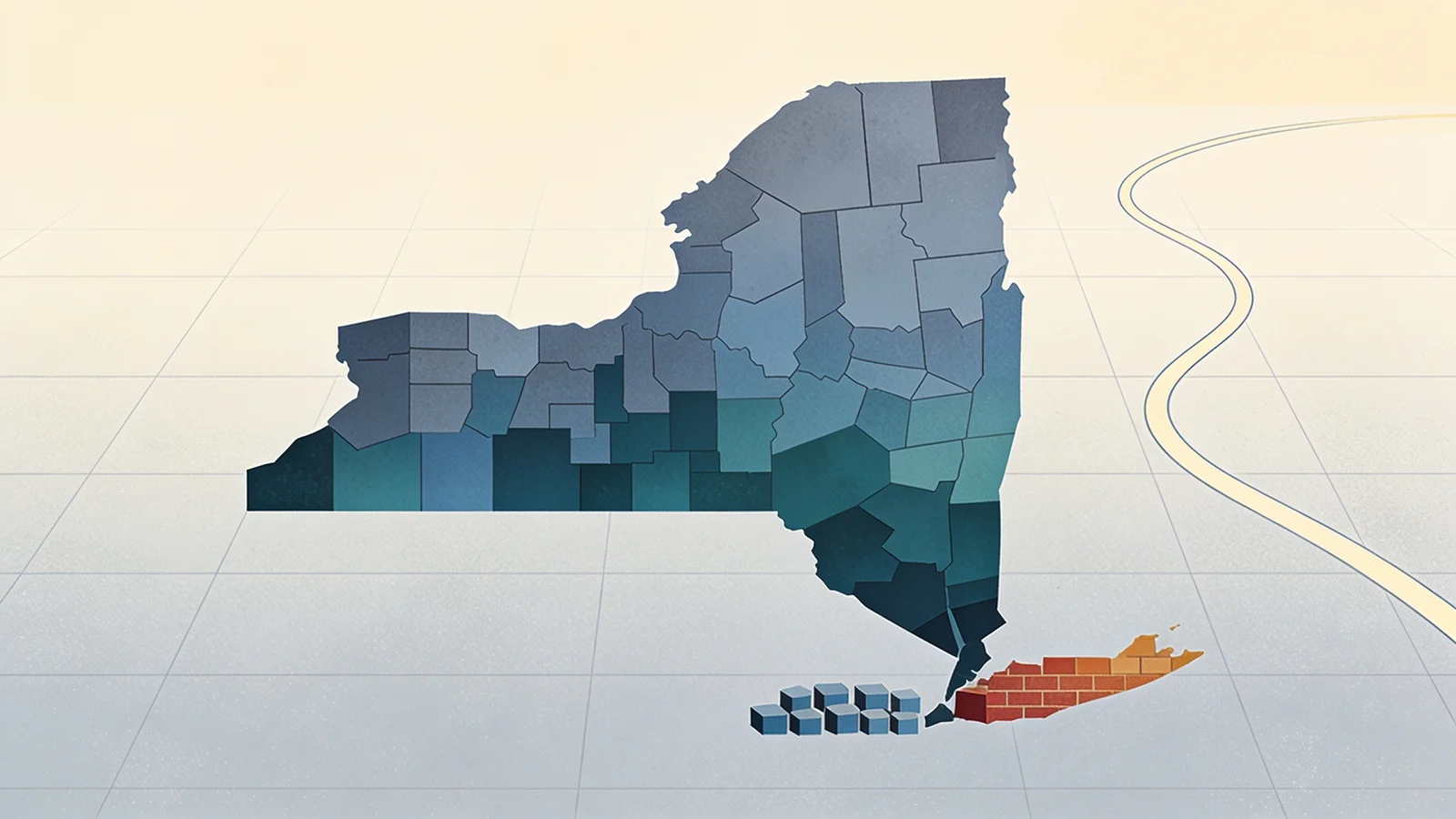
Westchester County counted 112 fatal overdoses in the 12 months ending in March, up from 79 the year before. That is 33 more deaths, the biggest increase any New York county posted in the federal government's provisional overdose file, and a 42% rise.
The state as a whole moved the other way. The Centers for Disease Control and Prevention's provisional estimates put New York's 12-month toll at about 3,700 for the period ending March 2026, against roughly 4,200 a year earlier — a drop of some 11%. Nationally the decline was 11.9%, to about 68,000 deaths, extending the retreat from the fentanyl peak that began in 2024.
Both numbers are real, and the distance between them is the story. New York is improving on average, which is what gets announced. Underneath the average, a ring of counties — Westchester, Rockland, Orange, Staten Island — is moving the other direction, and the federal file that records it publishes quietly, once a quarter, with no press release attached.
Eight counties moving against the current
The file is the National Center for Health Statistics' county-level cut of provisional overdose deaths, refreshed on October 4 and built from death records sorted by county of residence. It compares the 12 months ending in March 2025 with the 12 months ending in March 2026, which makes it one of the few public sources that can be read county by county without waiting two years for final data.
Of New York's 62 counties, 37 have countable figures in both periods. Twenty-seven of those fell. Two were flat. Eight rose.
Across the 37, deaths went from 3,873 to 3,404 — 469 fewer, a 12% decline that lands almost exactly on the statewide figure and suggests the county rows, read together, are tracking something real.
| County | 12 months to Mar. 2025 | to Mar. 2026 | Change |
|---|---|---|---|
| Westchester | 79 | 112 | +42% |
| Rockland | 23 | 36 | +57% |
| Richmond (Staten Island) | 90 | 100 | +11% |
| Otsego | 10 | 18 | +80% |
| Orange | 57 | 60 | +5% |
| Cattaraugus | 13 | 16 | +23% |
| Jefferson | 20 | 22 | +10% |
| St. Lawrence | 12 | 13 | +8% |
| Bronx | 638 | 562 | −12% |
| Brooklyn | 501 | 449 | −10% |
| Manhattan | 383 | 311 | −19% |
| Queens | 327 | 280 | −14% |
| Suffolk | 301 | 262 | −13% |
| Erie | 278 | 214 | −23% |
| Nassau | 168 | 123 | −27% |
| Broome | 53 | 33 | −38% |
The increases are not all the same animal. Rockland's 57% is 13 deaths on a base of 23, a jump that a single bad batch can produce. Otsego's 80% is eight deaths in a small rural county. Westchester's 33 is a different order of magnitude — large enough to survive ordinary noise, and recorded in a county with a full hospital system and a suburban tax base.
Orange County's three-death bump looks trivial by comparison until you notice that it is the third Hudson Valley county in the table. Add Westchester, Rockland and Orange together and the region added 49 deaths while the rest of the countable state subtracted 518.
The quarter of the state that isn't in the table
Twenty-five New York counties appear in neither column. NCHS withholds exact counts when a county records between one and nine overdose deaths in a period, a long-standing confidentiality rule, and for those counties the file prints a footnote instead of a number.
The suppressed list runs through small-city and rural New York: Allegany, Chenango, Clinton, Columbia, Cortland, Delaware, Essex, Franklin, Genesee, Greene, Hamilton, Herkimer, Lewis, Livingston, Orleans, Putnam, Schoharie, Schuyler, Seneca, Tioga, Warren, Washington, Wayne, Wyoming, Yates. Putnam is the surprise — a Hudson Valley county that spent part of this year arguing with its own towns over where to put a crisis stabilization center, and which now has no trend in the federal file either way.
Nationally, the same rule makes close to half of all American counties unreadable for year-over-year comparison, which is why the Axios analysis that first pulled this dataset apart this month could classify 1,624 counties — 842 falling, 430 rising, 352 unchanged — and leave the rest blank.
There is an uncomfortable consequence for planning. The counties where the file goes silent are, with few exceptions, the counties where the nearest opioid treatment program is a long drive and the nearest emergency department may be twenty minutes past that. A county that records eight deaths instead of nine disappears from the table everyone uses to describe the epidemic.
Some of these numbers will move
The county file publishes reported counts, not the adjusted "predicted" figures CDC uses at the state level, and it carries a separate column for the share of death records still pending investigation. That column is the difference between a trend and a guess.
The pending-records problem
In Monroe County, 70% of the records behind the 2026 figure were still pending when the file was cut, so its apparent 5% decline may not survive the next refresh. Nassau is at 43%, which makes its eye-catching 27% drop softer than it reads. Counties with high pending shares are not lying to anyone; they are simply still counting, and the CDC's own technical notes warn that provisional counts are revised upward as investigations close.
Westchester's cleaner number
Westchester runs the other way on data quality. Its pending share fell from 10% to 3%, meaning the 112 is closer to complete than the 79 it is being compared against. That does not prove the increase is a trend, but it removes the easiest explanation for dismissing it.
The same logic applies unevenly to the rest of the eight. Rockland's pending share rose slightly, Otsego's fell. None of the four largest increases looks like a reporting artifact.
Staten Island's two numbers
In October, New York City's health commissioner stood at a Staten Island business breakfast and said the overdose death rate in the borough had fallen by 49% in the last year on record, crediting naloxone vending machines paid for with opioid settlement dollars as part of the reason.
The federal county file says Richmond County went from 90 deaths to 100.
Both can be true, and the gap is a lesson in how this data gets used. The city's figure comes from its own calendar-year reporting and its own rate calculations. The CDC figure is a rolling 12-month window that ends three months later and counts reported deaths rather than rates. A borough that fell sharply through mid-2025 and then turned back up would produce exactly this split.
Whichever number gets quoted in a funding cycle tends to become the official story. Providers on the island will tell you the caseload never really dropped, and the federal file at least leaves the door open that the improvement stalled.
The Bronx is still where the deaths are
It is easy to lose the scale of the place in the percentage columns. The Bronx fell 12%, and it still recorded 562 overdose deaths — more than Westchester, Rockland, Orange, Putnam, Dutchess and Ulster combined, and more than any other county in the state by a wide margin.
OASAS data put the Bronx's overdose death rate above every other county in New York. The city health department's quarterly report counted 456 confirmed overdose deaths across the five boroughs in the third quarter of 2025, with opioids involved in about 78% of them, or one death roughly every five hours.
The shape of the decline matters too. Governor Hochul's office said in August that predicted statewide deaths fell from more than 6,630 in 2022 to 3,775 in 2025, a decline of about 45%, and the rolling figures in this file are consistent with that. Synthetic opioids are still implicated in roughly six of every ten overdose deaths in the state, and fentanyl deaths have fallen faster than cocaine deaths, which in New York City have been close to flat for a year.
What changes on January 1
The next thing likely to move these numbers is not a drug or a program. It is paperwork.
Starting January 1, 2027, adults covered through Medicaid expansion and certain waiver programs will have to document at least 80 hours a month of work, school, job training or volunteering, or meet an income test, to keep coverage. The requirement comes from H.R. 1, the federal law signed in July 2025. The city says it has contacted more than 35,000 providers and trained staff to help people prove eligibility, and its health commissioner has described the rule as built to put "the burden on individuals to prove they qualify."
Medicaid pays for most buprenorphine and methadone treatment in New York. Providers have warned for a year that any break in coverage becomes a missed dose, and missed doses become relapse risk within days for people on opioid agonist treatment. A county that just posted a 42% increase in overdose deaths has more to lose from that than a county posting a decline.
What to watch
The next quarterly refresh will add deaths through June 2026, and it will show whether Westchester's rise was a one-year spike or the start of a suburban second wave. Health departments in the Hudson Valley have not published an explanation, and the state's overdose dashboard does not break out the suburban counties in a way that would surface one.
For families, the practical items have not changed. Free naloxone and drug test strips can be ordered from OASAS at forms.ny.gov/s3/Harm-Reduction-Order-Form, and New York pharmacies cover copays of up to $40 on nasal spray. The state's 24/7 HOPEline is 1-877-846-7369, or text HOPENY to 467369. The 988 line takes crisis calls, including ones that involve drugs.
The county file itself is public and free at data.cdc.gov, for anyone who would rather check their own county than take a summary's word for it.
Written by
MTNYC Editorial TeamThe MTNYC Editorial Team is a group of healthcare writers, researchers, and addiction specialists dedicated to providing accurate, compassionate, and evidence-based information about addiction treatment and recovery resources in New York State.